
Pet Stain and Odor Removal in Erie, PA
Pet urine soaks through carpet into the backing, the pad and sometimes the subfloor. Surface deodorizer masks that for a few days. We treat the source with enzymes, extract it out, and tell you honestly when the pad needs replacing instead.
How Deep Has It Gone?
How far the urine travelled decides what can be fixed and what cannot. This gives you a realistic answer before anyone quotes you.
How Deep Has The Urine Gone?
Three questions tells you what is realistically fixable before you spend anything.
Why The Smell Keeps Coming Back
Urine does not sit on top of carpet. It soaks through the face fiber into the backing, then the pad, and with enough repetition into the subfloor underneath.
As it dries it leaves behind uric acid crystals bonded to the fibers. Those crystals are odorless when fully dry and reactivate the moment humidity rises. That is why a room can smell fine in January and strongly of ammonia in September.
Store-bought deodorizer sprays sit on top of those crystals and mask the smell for a day or two. They do nothing to the source. The only thing that removes it permanently is an enzyme that breaks the crystals down, followed by extraction that flushes the residue out.
Surface, Backing, Pad, Or Subfloor
We check with a UV light and a moisture meter before quoting anything, because these four situations need very different work.
| Depth | What it means | Realistic outcome |
|---|---|---|
| Surface only | Caught early, still in the face fiber | Usually removes fully |
| Into the backing | Soaked past the fiber into the carpet backing | Usually resolves with enzyme treatment and extraction |
| Saturated pad | Repeat accidents in the same spot over months or years | May need pad replacement in that section |
| Into the subfloor | Years of accidents, common with older or unwell pets | Cleaning alone will not fully resolve odor, and we will say so |
We would rather tell you the pad needs replacing than take money for a cleaning that leaves the smell behind.
Pet Stain and Odor Removal in Erie: How We Treat It
- UV inspection across the whole room, not just the spot you point at. Urine fluoresces under blacklight, and most homes have areas the owner has not noticed.
- Moisture meter reading to judge how deep it travelled and whether the pad is holding it.
- Enzyme applied at the source and given real dwell time. Enzymes need minutes to break the crystals down. Spraying and immediately extracting does almost nothing.
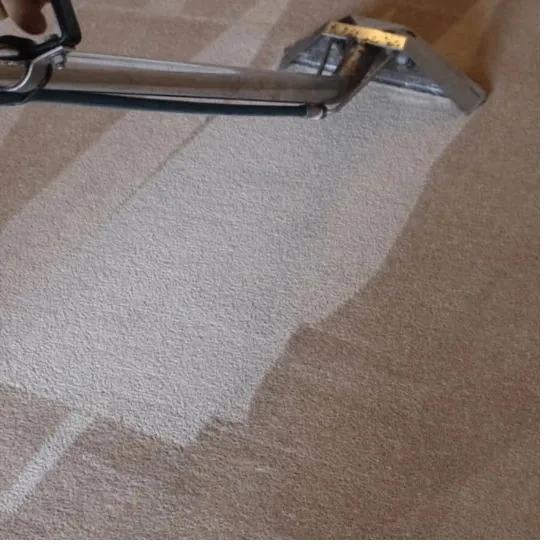
- Hot water extraction at 180 to 200 degrees to flush the broken-down residue out.
- Sub-surface extraction where the pad is involved, using a tool that pulls from below the carpet rather than across it.
- Speed drying so nothing stays damp and starts smelling again.
What Not To Do
A few common reactions make the problem permanent. If you do nothing else, avoid these four.
Do not apply heat. Steam irons, hair dryers and hot water from a household machine all set urine protein into the fiber permanently. Heat is the single most common way a treatable stain becomes untreatable.
- No ammonia-based cleaners. Urine already contains ammonia. Using more can encourage a pet to mark the same spot again.
- Do not scrub hard. Scrubbing spreads the stain wider than the original accident and can distort the pile so it never lies flat again.
- Do not soak it with more water. That drives urine deeper into the pad, turning a surface problem into a sub-surface one.
What actually helps
Blot with a white towel, pressing straight down rather than rubbing. Keep moving to dry sections until you stop lifting moisture. Then leave it alone and call. Fresh accidents blotted within a day have the best odds of coming out completely.
Why Erie Homes See This More
Two things make pet odor worse here than in a drier climate.
Lake humidity. Proximity to Lake Erie keeps indoor humidity higher than inland Pennsylvania, especially September through December. Higher ambient moisture reactivates uric acid crystals more often, so the smell returns more frequently and more strongly.
Original padding. More than half of Erie homes were built before 1959, and many have had carpet replaced once while the original pad stayed in place. A brand new carpet sitting on a pad that absorbed a decade of accidents will smell within days. We check the pad before promising anything, because that single fact decides whether cleaning is worth doing at all.
What Affects The Cost Of Pet Treatment
- Number of affected areas, including ones found under UV that you had not spotted
- How deep the urine travelled, since sub-surface work takes longer than a surface pass
- Whether the pad needs partial replacement
- Total square footage being cleaned alongside the treated areas
- Whether subfloor sealing is needed
- Stairs, which take longer per square foot than open floor
We confirm your price before any equipment turns on. No published rates, because stain age and depth vary so much between homes that a figure here would be wrong for most people reading it.
When Cleaning Will Not Solve It
- Subfloor saturation. Once urine has soaked into wood subfloor across a wide area, cleaning the carpet above it does not remove the source. That needs sealing or replacement.
- Delaminated backing. If repeated soaking has separated the carpet backing from the face fiber, the carpet is structurally finished regardless of how clean it looks.
- Carpet near end of life. If the fiber is already worn flat and the pad is contaminated, replacement is usually better value than repeat treatments.
- Dye damage. Urine left long enough can strip or alter carpet dye. That colour change is permanent and no cleaning restores it.
We tell you which of these applies during the assessment, not after taking a booking.
Pet Odor Questions From Erie Homeowners
Can old pet stains actually be removed?
It depends how deep the urine traveled. Surface and mid-layer staining usually responds well to enzyme treatment and extraction. If urine has fully saturated the pad and subfloor over years, cleaning alone may not resolve the odor, and we tell you that during the assessment rather than overselling a result we cannot guarantee.
Why does the smell come back on humid days?
Urine dries into crystals that bond to the carpet backing. Those crystals sit dormant when dry and reactivate when humidity rises. In Erie that happens often, because lake humidity stays high through the fall. Deodorizer masks it for a few days. Only breaking down the crystals removes it.
Is enzyme treatment safe for my pets?
Yes. Enzymes break down organic material and rinse out with the extraction. Keep pets off the carpet until it is dry, mostly so they do not track soil back onto a clean surface.
Should I just replace the carpet instead?
Sometimes that is the honest answer. If the pad and subfloor are saturated across a large area and the carpet is already near the end of its life, replacement makes more sense than repeat cleanings. We say so if that is what we find.
Do you treat the pad and subfloor?
We do sub-surface extraction where the pad is involved. If the subfloor needs sealing, that is a separate step we explain before doing anything.
Why did the stain reappear a few days after cleaning?
That is wicking. The visible spot came out, but urine still in the pad travelled back up as the carpet dried. It means the job needed sub-surface work rather than another surface pass.
Do cats and dogs need different treatment?
The approach is the same, but the pattern differs. Cat urine is more concentrated and cats tend to repeat in one protected spot, so damage goes deep in a small area. Dog accidents are usually higher volume spread wider, affecting more square footage but often staying closer to the surface.
Can you find spots I have not noticed?
Yes. We use a UV blacklight, which shows urine that is invisible in normal light. It is common to find two or three areas a homeowner did not know about, and treating only the obvious spot is why smells linger.
Related Services
- Residential Carpet Cleaning
- Commercial Carpet Cleaning
- Move-In and Move-Out Cleaning
- Upholstery and Furniture Cleaning
- See all services
Available across Erie County: Erie city (16501, 16502), Millcreek (16505, 16506, 16509), Harborcreek (16421), Fairview (16415), North East (16428), Waterford (16441), Edinboro (16412) and Girard (16417).
Get the smell out for good
Free assessment with UV inspection, and an honest answer about what is fixable.
Get My Free QuoteCall (877) 658-1206Areas We Serve
Each area page covers what carpet in that part of Erie County actually deals with, from Presque Isle sand to well water iron.
Industry standards. Our technicians are certified by the IICRC, the Institute of Inspection, Cleaning and Restoration Certification, which sets the cleaning and restoration standards this industry works to. For independent guidance on indoor air quality and moisture, the US EPA publishes useful homeowner resources.